Research Meets Airport Operations
First understand the problem, then develop solutions.
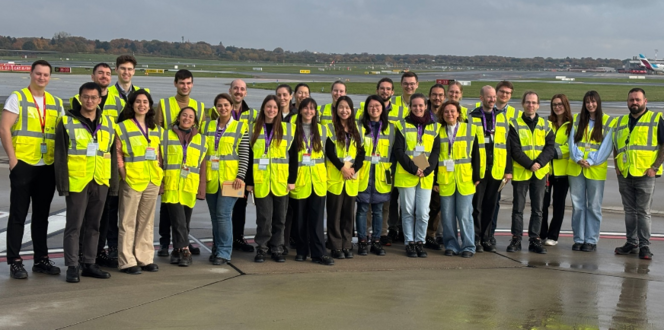
During the High-Tech Design Sprint 2026, 18 researchers left their labs and desks behind for one week to head to Hamburg Airport and our foundation, where they then worked alongside DESY to develop solutions for ground handling challenges.
It is not technology that comes first, but need. Following an approach inspired by Stanford Biodesign, the researchers learned to first closely observe and understand problems before developing possible solutions. To do this, they gained insights into on-site workflows, observed processes, and spoke with employees about specific challenges. The interdisciplinary teams then used this information to identify needs and generate initial ideas for solutions.
Participants' Experiences
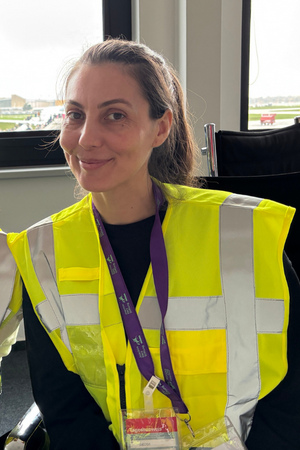
For Adriana Pitea (Head of Data Science at Aden Health), this shift in perspective was a new experience: “The approach helped me think more systematically about how a completely new idea or innovation can emerge.” From her day-to-day work in the industry, she is familiar with the pressure to quickly produce viable results. Taking the time to thoroughly engage with the problem first gave her a different perspective on innovation processes.
For Friederike Eilts (Group Lead for Bioprocess Engineering DSP at the Virus-based Therapies branch of the Fraunhofer Institute for Interfacial Engineering and Biotechnology IGB), the approach meant questioning familiar ways of thinking: “As an engineer, I’m used to thinking in a very solution-oriented way. Consciously refraining from looking for solutions right away and instead remaining open-minded was frustrating for me at first.”
For Sarah Haggenmüller (Molecular Engineer, Technical University of Munich (TUM)), it was also unusual to deliberately set aside possible solutions at first. It was especially during discussions with employees that she realized the value of this approach: “Some things that initially seemed like problems to us were viewed quite differently by the employees. That showed me how important it is to listen and understand first before developing solutions.”
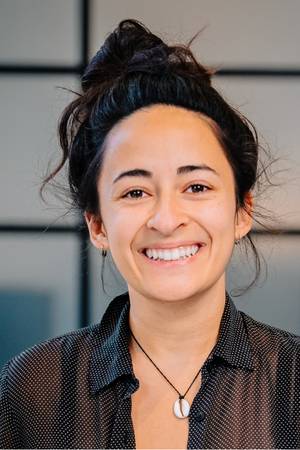
This is precisely the shift in perspective that the participants want to bring into their day-to-day research: to start more from the problem itself rather than from an existing technology. “In research, we’re constantly solving problems, both big and small. In doing so, we tend to settle on a solution very quickly. The sprint showed me how valuable it is to spend more time with the problem itself: to truly understand it, to shed light on its various causes, and in doing so, to uncover the more fundamental questions,” says Sarah.
In this way, the High-Tech Design Sprint also bridges the gap to technology transfer: How does research give rise to solutions that actually meet a specific need?
New Perspectives Through Interdisciplinarity
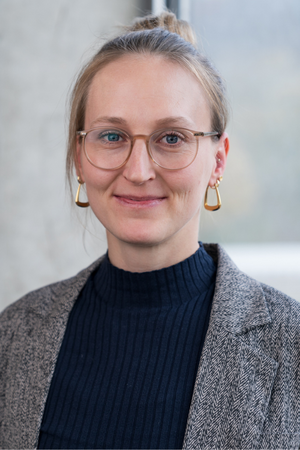
New insights also emerged from the participants’ diverse professional backgrounds. Adriana, who works in data science and machine learning, recognized connections between ground handling and her own research: methods she uses for biological and medical data could also help optimize processes in a completely different environment.
For Friederike, the added value also lay in looking beyond her own field. She found the diverse professional perspectives and the opportunity to immerse herself deeply in a completely new subject area for five days particularly enriching.
Sarah, too, is incorporating this shift in perspective into her own research and startup work. While the Business Model Canvas focuses on an existing business idea and its target audiences, the approach tested in the sprint starts earlier: with specific needs. “If I truly understand the needs, I can tailor the idea specifically to address the most important ones, rather than searching for needs that fit a ready-made solution,” says Sarah.
Thereby, the Sprint became a testing ground for knowledge transfer: expertise from various disciplines met real-world challenges, and scientific expertise addressed the question of where it can make a difference in practice.