How to Give a Great Pitch
Interview with Martin Ostermayer
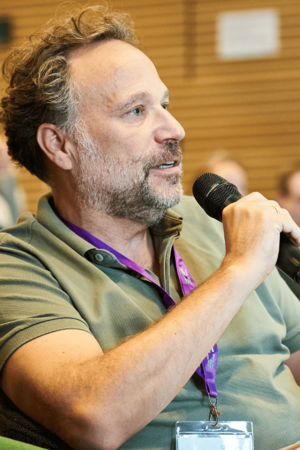
Martin Ostermayer is an investor, founder, and adjunct professor at the University of Hamburg Business School. Over the course of his career as a venture capitalist, he has brokered or personally invested in stakes in approximately 60 tech startups, some of which are in the deep tech sector. About 30 of these remain in his active portfolio to this day.
He sold the remaining investments—sometimes at a profit, sometimes at a loss, and sometimes the money was lost entirely when the startup went bankrupt. “Bankruptcies,” says Ostermayer, “are part of the business.”
Your LinkedIn profile features a mountain range as the background image. Is this a metaphor for the mission of startups and investors in the deep tech sector?
Yes, the image conveys several messages. For one thing, I myself enjoy hiking for days on end across multiple peaks, from hut to hut. With their ups and downs, such hikes are also a good analogy for the journeys of startups and investors. When they set out together, though, they have more than just a few grueling days ahead of them. They spend years—sometimes even decades—together.
As an investor, you've backed many startups based on compelling pitches. What makes a good pitch in your opinion?
I’m drawn to pitches that are kept simple and offer an “aha” moment. My interest is piqued when a problem is outlined so clearly that I think: “That’s right! I hadn’t thought of that yet!” Next, the founders need to be able to explain the solution to the problem in a way that’s easy to understand. This second point is really not easy in the highly complex field of deep tech.
Is there anything else?
Yes, the proposed new solution must be better than previous alternatives and have the potential to reach the largest possible market. As an investor, I need to be convinced that the founders know the market inside and out and are both able and willing to capture it with their business idea. If I realize that they don’t know the market themselves and base their market analysis solely on analysts, I’m out.
The three points mentioned above can also be found in the pitch templates that are available in abundance on the Internet. So why do deep tech pitches still go wrong so often?
Scientists generally find it very difficult to describe the problem and the solution they’ve found in a concise and abstract enough way that non-experts can understand it. Instead of engaging investors, researchers dive into the details far too quickly. They want to convince investors with their technical expertise. That’s understandable, but at this early stage, it’s fundamentally wrong. What’s truly off-putting to me as an investor, moreover, is when I can’t detect any business acumen within the team.
7 Investments Out of 1,000 Pitches
The selection process in the venture capital business is tough, and decisions are made at breakneck speed. As a venture capitalist, Martin Ostermayer typically spends no more than 30 seconds on a pitch deck. If he gets stuck somewhere while flipping through the pitch deck, that’s a good sign. Then he reads more slowly—and the startup teams are more likely to be invited to a one-hour introductory call. Ostermayer doesn’t keep selection statistics. But he estimates that while scanning 500 to 1,000 pitch decks, no more than 150 catch his eye. Even fewer pass his in-depth review, and in the end, perhaps only a handful of startups result in an investment. “Seven investments out of 1,000 pitches is a realistic figure,” says Ostermayer.
What advice do you give teams in situations like these?
Basically, everyone should want to make money together and figure out who on the founding team has a feel for the market. If the team lacks such a person, it needs to be expanded accordingly. That brings me to what is probably the most important point.
And who would that be?
Founders need to be storytellers. That’s the most important thing. It’s not enough to just be convinced of your own cause. You have to be able to get others excited about your idea and convince them to get on board. To me, a good pitch is like speed dating, where I can fall in love with the idea and the people behind it.

So, to succeed in the speed-dating session with you, a team would be well advised to put their best storyteller with the most charisma at the front...
... and many research teams find that rather difficult. To deliver a really good pitch, the team must question its own hierarchy and, if necessary, turn it upside down. While in research the person with the highest level of subject expertise usually takes the lead, when it comes to pitching, the person with the strongest storytelling skills is the one needed.
Does that apply to all pitches?
Yes. Fundamentally, there are three reasons to invest: the team, the team, and the team. That’s why the introductory call after a successful pitch is so important to me. It lasts about an hour and gives a good sense of whether and how the team members interact with one another and what roles they each play based on their individual skills. It’s easy to tell whether there’s mutual respect within the team and whether the “top dogs” can take a back seat.
Is AI allowed in the pitch deck?
AI chatbots can be a huge help when working on a pitch deck. Martin Ostermayer, at any rate, advises founders to use these tools. Whether it’s researching market potential and analyzing the competition, designing the visual layout, or refining specific phrasing—AI tools can improve pitch decks. But be careful: Investors, of course, also use AI tools and run their hypotheses and market forecasts through them before an introductory call. “AI certainly doesn’t make the game any easier,” says Ostermayer, “and that goes for both sides.”
Do you see yourself as part of the team?
Absolutely! As an investor, I support the team through all the lows and tough times. I don’t just invest money—I also personally invest my time and energy. That’s why it’s so challenging and draining for us investors: because during crises, we can’t contribute anything from a technical standpoint. Nevertheless, investors play a key role in such situations. They can share experiences from crises faced by other portfolio companies. Experienced investors also don’t “panic” as quickly as first-time founders do, which helps enormously in crisis management.
What do you think of teams that have failed in the past?
When a pitch describes a setback and how to deal with it, that’s just awesome. In Germany—and especially in academia—failure still carries a negative connotation. In fact, the learning curve is extremely steep when you face setbacks. I’m convinced that anyone who’s passionate about what they do will, sooner or later, lead a startup to success. By the way, the learning curve starts right from the pitch. Setbacks help you grow there, too. The best way to learn how to pitch is by pitching.
As a venture capitalist, how do you deal with bad investments?
The money that people like me invest has to be money we can truly spare. If it’s gone, it shouldn’t hurt or affect our standard of living. Still, the term “venture capital” is a bit misleading, because such investments are, of course, all about minimizing risk. We look for teams that we believe are better than others. We try to invest in solutions with high market relevance. We’re looking for the needle in a haystack that has what it takes to turn into gold.
The interview was conducted by journalist Christine Prußky for the Joachim Herz Foundation.